Published by Jeremy. Last Updated on October 14, 2025.
Disclaimer: Our site uses demographic data, email opt-ins, display advertising, and affiliate links. Please check out our Terms and Conditions. Pricing, operating hours, or menus may have changed since our initial visit and may not be reflected in subsequent updates. Please confirm these directly with any business prior to visiting. To see more of our content, set us as a Preferred Source in Google.
When it comes to parking in Pittsburgh, odds are good you are going to see a lot of signs. We have a lot of them.
Signs to denote when there are meters. Signs to denote permit parking. Signs to denote delivery parking. Many neighborhoods also have street cleaning rules to consider, too.
We often hear from visitors who find our parking signs to be confusing. So in this one, we thought we’d break down some of the most common parking signs you’re likely to see, and share what each means in an (hopefully) easy-to-follow guide.
Note: This article only covers meter, permitting, and street cleaning signs within the city of Pittsburgh. Boroughs and suburbs may have different rules and signs to watch out for.
🏨 Book a Hotel in Pittsburgh
- Great Value: Drury Plaza offers excellent prices downtown.
- Good Views: Sheraton Station Square features stellar views from river-view rooms.
- Free Parking: Hampton Inn Strip District includes free parking and a great location.
🏡 Looking for an apartment rental? Find a deal on Airbnb!
Metered Parking Signs
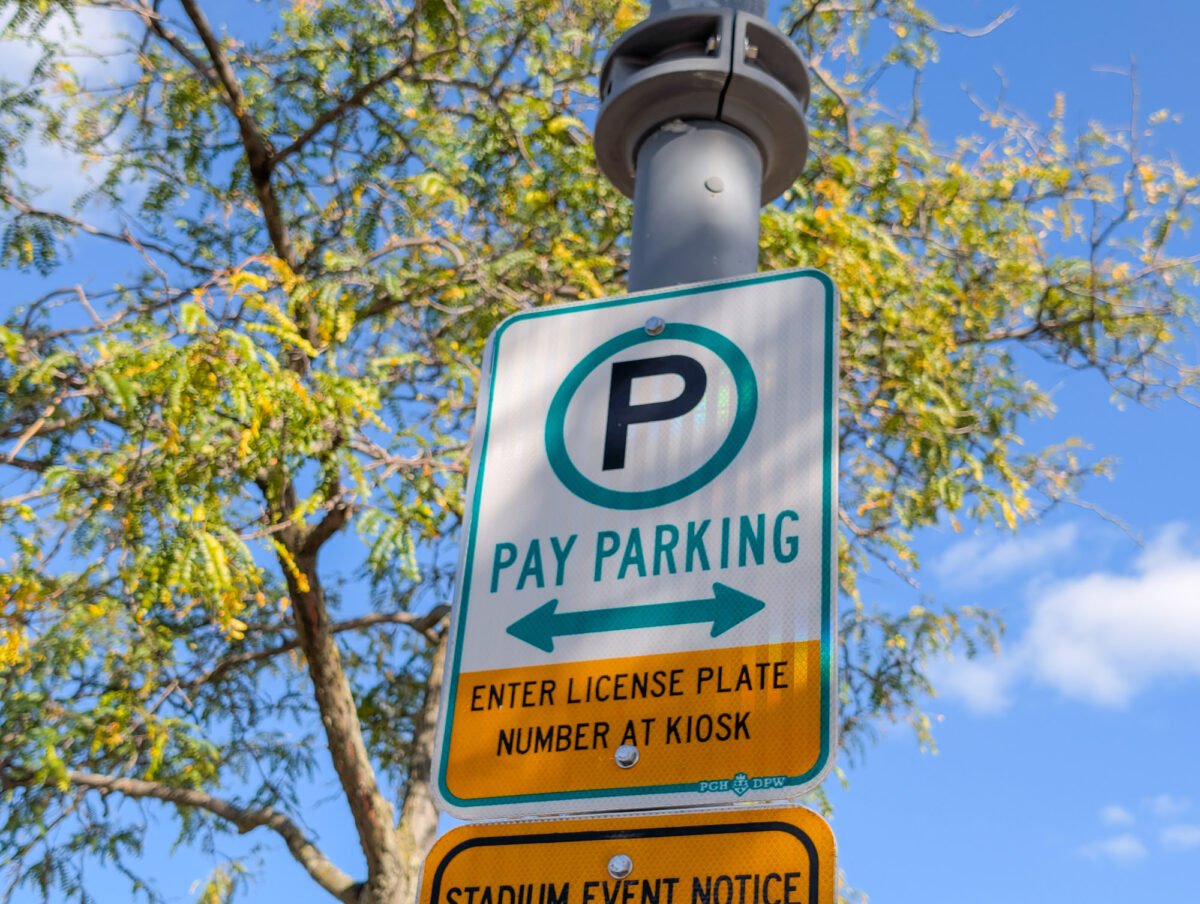
Metered parking zones in Pittsburgh are perhaps the easiest signs to read. Why? They’re pretty obvious. You simply have a sign denoting Pay Parking, and arrows showing the directions. Arrows at the end of the zone will point in one direction (paid parking starts here in the direction the arrow is going), whereas parking signs in the middle of the zone will point both ways, like in the image above.
If you are parking within an area that has these signs, you’ll need to look for a parking kiosk to pay for parking.
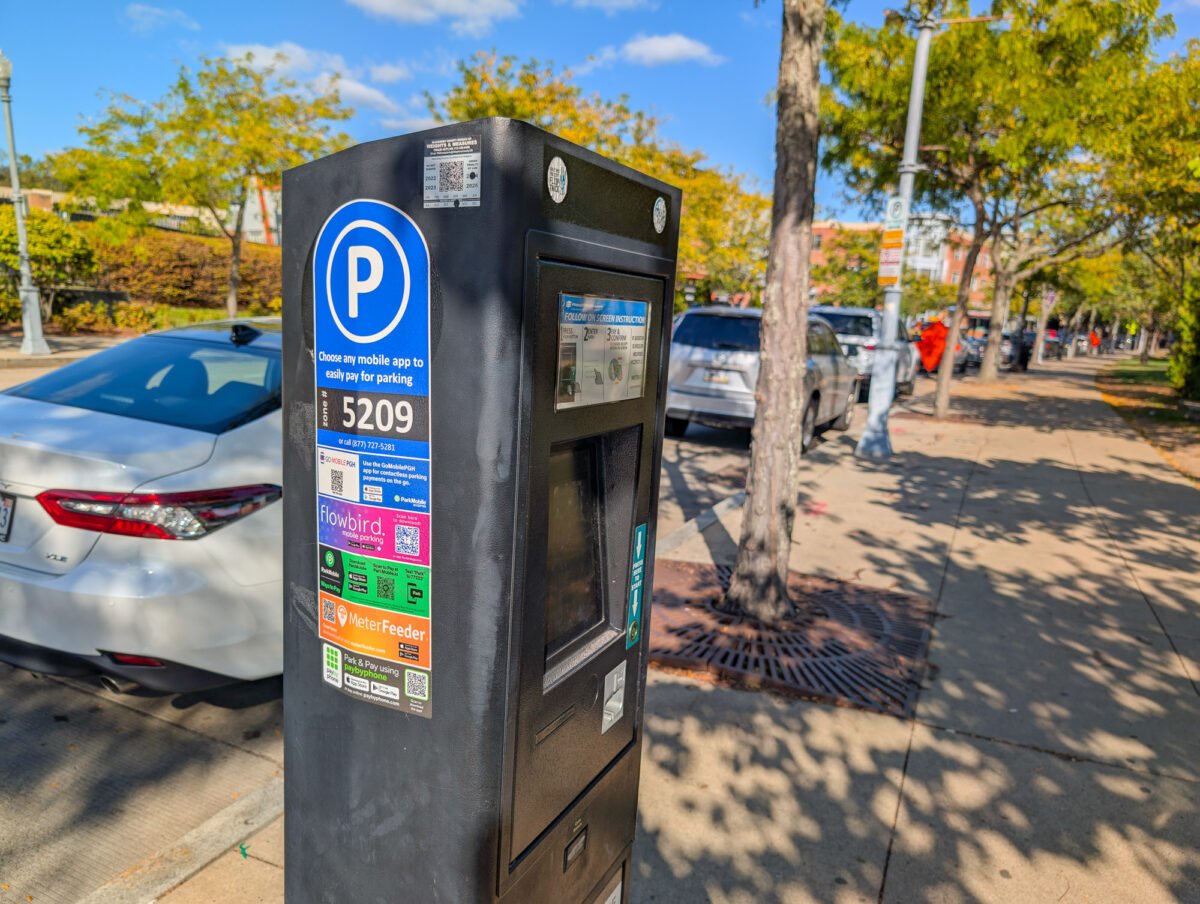
The kiosks are placed at regular intervals, so you should be able to see one pretty easily when on the sidewalk, looking in both directions. The kiosks here can take payment either via the touchscreen or via a mobile app, and require you to insert your license plate, selecting a parking duration, and paying with credit card. A ticket does not need to be displayed on your dash as it is logged via your plate.
Paid street parking in Pittsburgh is typically not 24/7, so be sure to check the kiosk to see how long paid parking is enforced. Many neighborhoods require payment on weekdays and Saturdays through 6 pm; however, more popular business districts may be later. If paid parking is not enforced, parking is free, insofar as other restrictions do not override that (such as game day parking, which is often displayed on the kiosks and on nearby signs).
Finally, one perk of paying through the mobile app is you can add time if you need it, but it is worth noting that if you do not use all of the time, you do not get a refund.
How to Read Pittsburgh Parking Permit Signs
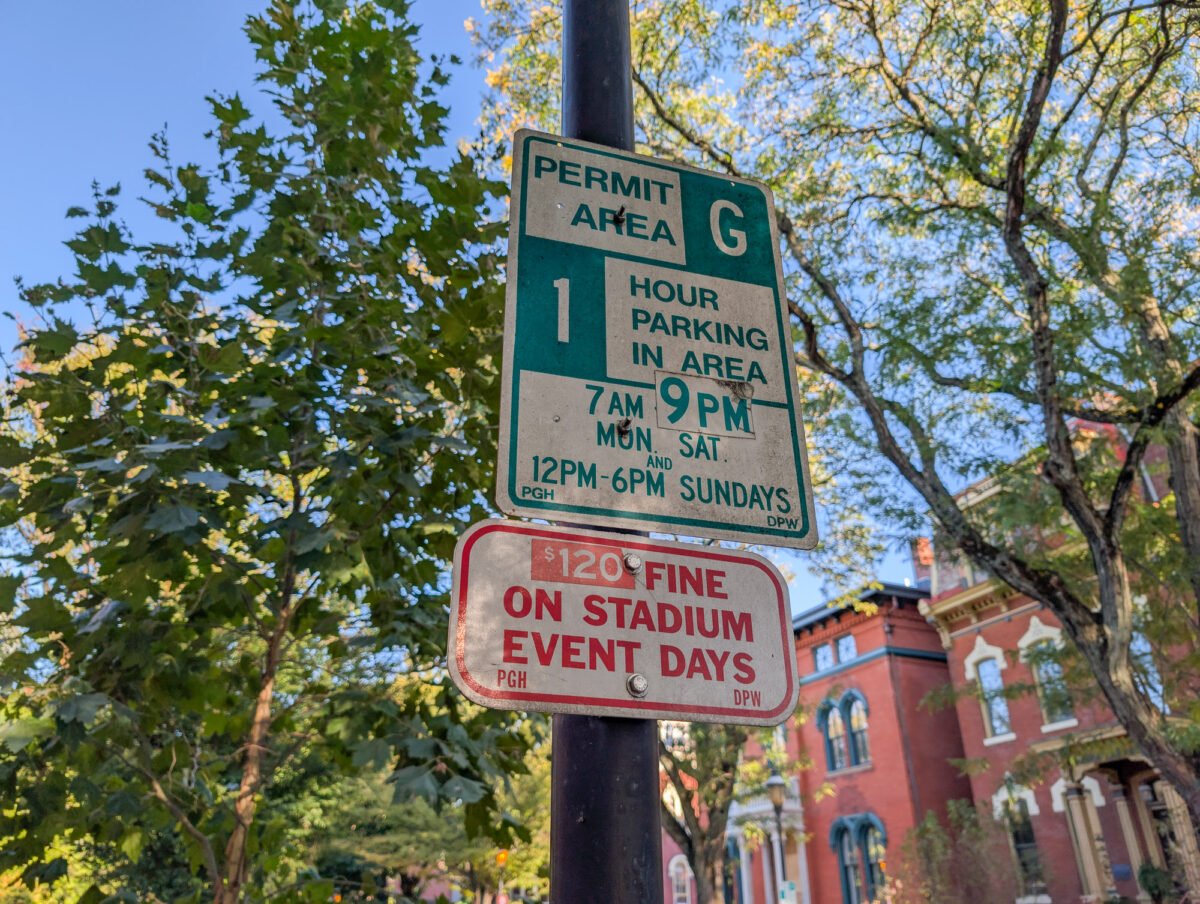
Pittsburgh Parking Permit signs appear complicated, but once you understand their format, they’re pretty easy to follow.
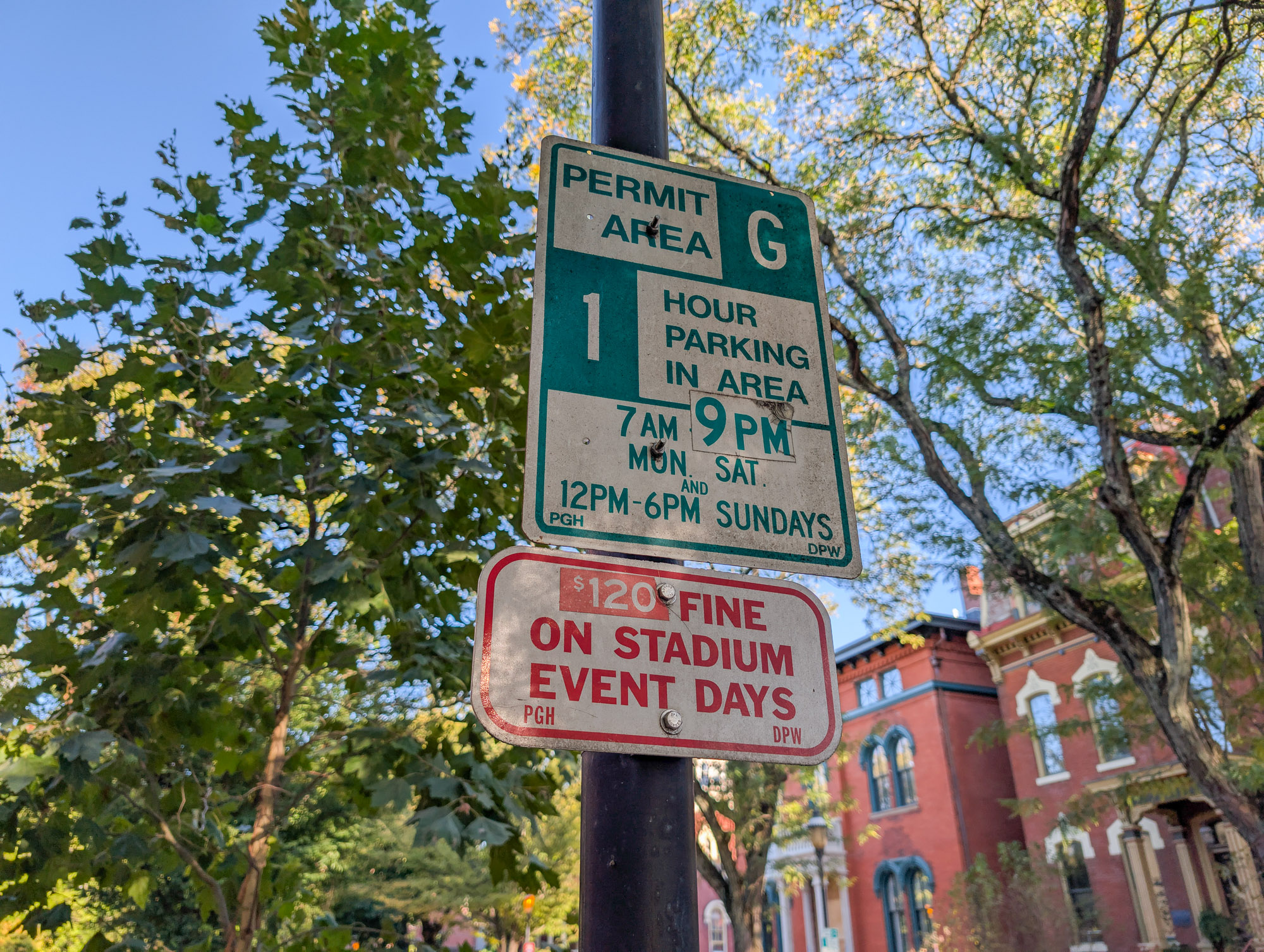
The big components of a sign are the zone ID, typically one or two letters, which identifies the permit type that can park on the street at all times. Residents who live in the neighborhood should be able to apply for a permit from the city to display on their vehicle, and may also be able to get a guest pass for visitors (which could come with additional requirements or limitations). These are only issued for the specific zone where you live, but if you have a permit, you can park as long as you like.
- In the above example, those with a Zone G permit can park as long as they like.
The numbers displayed on the sign highlight two important details for everyone else. The fixed hour that is listed (often 1 hour or 2 hours) is the length of time non-permitted vehicles are allowed to park for free during permit enforcement. The hour range, such as 7 am to 9 pm, is the hours in which permitting requirements are enforced. So if you’re parking in a neighborhood and you see 7 am to 9 pm on the sign with 1 hour listed, you’re allowed to park there for 1 hour for free from 7 am to 9 pm without a permit.
- In the above example, those without a Zone G permit can park for a maximum of one hour during the enforcement times listed.
If you arrive in the neighborhood after 9 pm, permitting is not enforced, and you can park until enforcement begins the following day. Some days may be excluded from permitting as well, but could vary from neighborhood to neighborhood. Sunday is a popular exemption, so if a sign also says “Monday-Saturday”, then permitting is not enforced on Sunday, and you can also park as long as you like until enforcement resumes on Monday in most cases. Some neighborhoods have enforcement seven days a week, so do not assume Sundays are always safe- check the sign.
Some neighborhoods where business districts are popular late in the evening (such as the South Side) may have later hours, so watch out for those as well. Many end at 6 pm, but that is not always the case- some can go much later. If a sign says 1 hour through midnight, then you can only park for one hour there throughout most of the day unless you have a permit.
- Meter Exceptions: Some parking permit zones can begin just outside of metered areas (which are standalone kiosks found at set intervals within the city limits) and may result in some confusion on what rules apply. Be aware that if you park within a metered area, you should pay at the nearby kiosk or the parking app. The kiosk should have more information on when meter parking fees apply.
- Game Day Exceptions: If you’re parking in the North Side near the stadiums, you may see additional signage for game day exceptions for Pirates and Steelers games. These are additional rules for game days, and often come with far higher parking fines that are noted for violators. Some signs may be no parking whatsoever, whereas others may be just a note for higher fines for violating the listed time. In metered areas, the restrictions are often visible on the parking kiosks as well.
Purple Parking Signs Are Different – Short Term Only
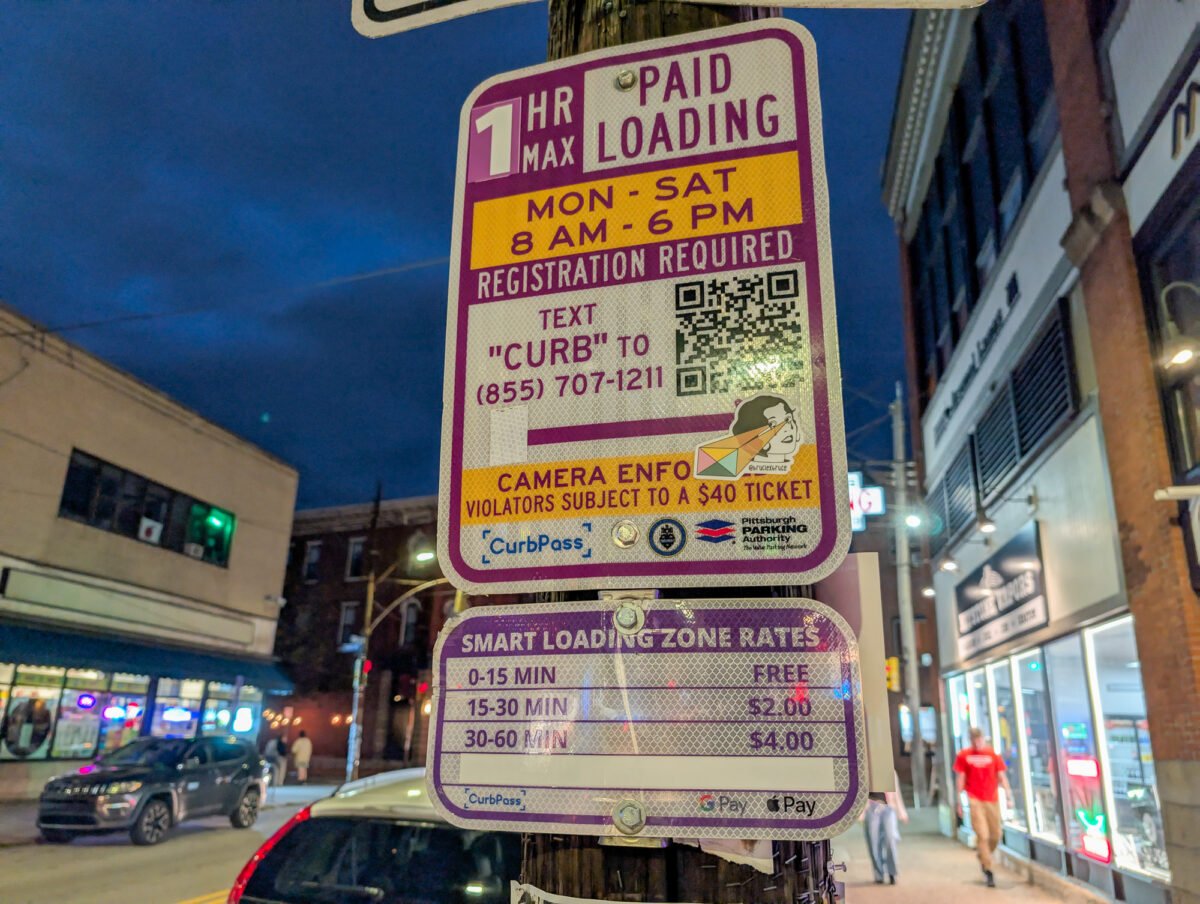
Pittsburgh recently rolled out a different kind of parking rule known as purple curb zones. These are different from conventional parking and are often found in popular business districts only for short-term parking. These signs often supersede permit or meter requirements in their own special category; however, street cleaning rules (below) may still apply.
These are meant to be Smart Loading Zones (SLZs), which charge a fee for short-term parking. The main difference here is that these have a camera present and monitor parking activity at all times during the enforcement period. You’ll typically note these by the purple parking signs, in a similar style to the above, and with purple curbs as well.
These are typically mostly used by delivery services and pickup spots for food drivers, and not your everyday visitor to a neighborhood. During enforcement, prices generally scale in price at 15-30 minute intervals and can be quite expensive compared to normal meters that may be found just one spot over.
Instructions are found on these signs for how to register your vehicle and pay (typically either via QR Code or texting a number), as well as showing if any extremely limited parking durations are available free. But don’t risk this one- a solid fine will be sent your way for violating purple zones.
We avoid parking in these and pay for a meter at all times. Keep these open for delivery companies as intended.
How to Read Pittsburgh Street Cleaning Signs
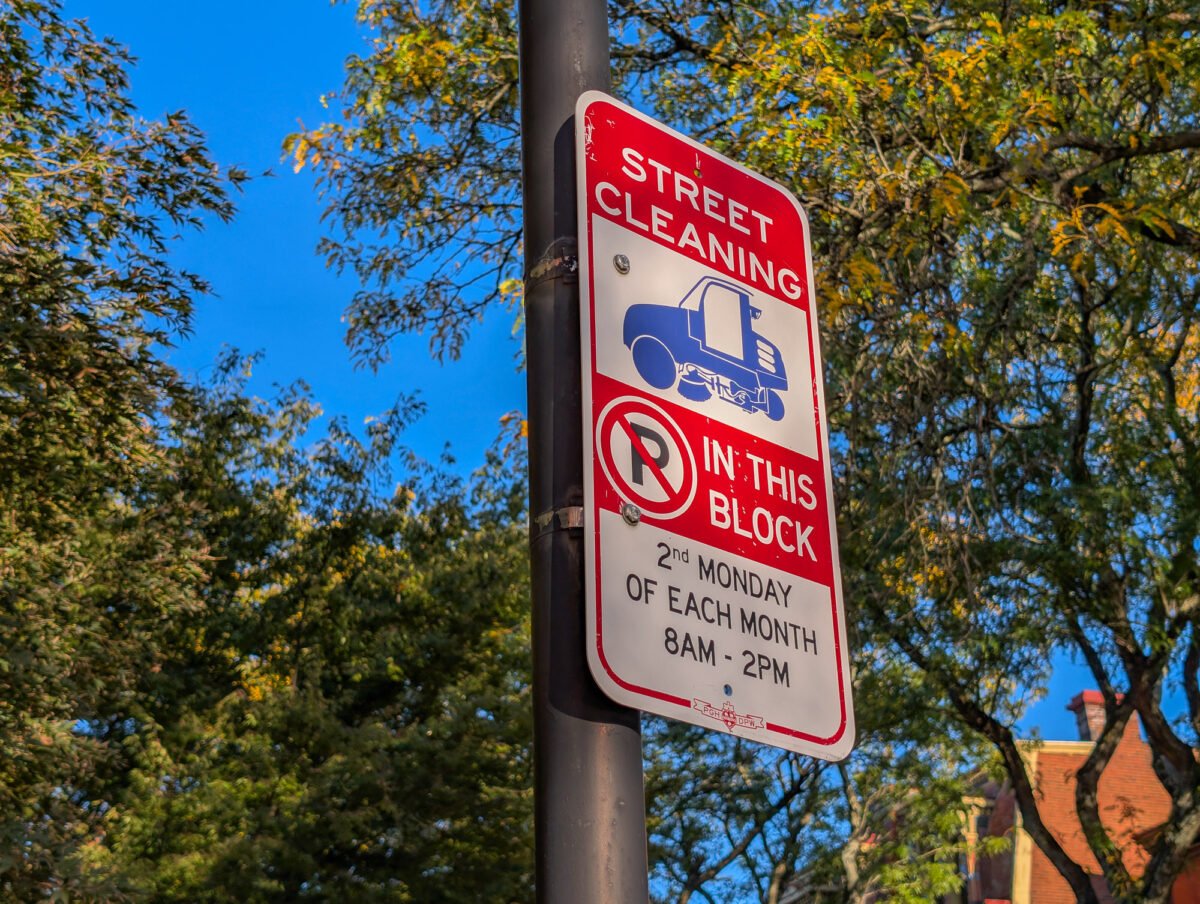
Street cleaning signs are distinctly separate from conventional permit signs and take priority over permit rules. Thankfully, they’re also much easier to follow.
To put it simply, street cleaning signs show the day of the month (such as first Monday, second Tuesday, etc.) and the time period (often 8 am to 2 pm) where no parking of any kind is allowed on that side of the street. It doesn’t matter if you have a permit. Absolutely no cars should park on that side of the street on that select day of the month and time period.
The only caveat here is that street cleaning is often only done seasonally, so most signs will have some form of notation of the months that it is valid- often April 1st to November 30th (the above example does not, however). So if you see a sign that says street cleaning is enforced on the First Tuesday, 8 am to 2 pm, April to November, then the first Tuesday of each month, do not park on that side of the road at all from 8 am to 2 pm.
Now, most streets we’ve seen with street cleaning have different rules for opposing sides of the street (we’ve not verified for all of them, of course). Our street, for example, has Second Monday on one side and Second Tuesday on the other. This allows locals to park on at least one side of the street on these days, but depending on how busy the street is, it may result in some difficulties finding a spot. If permit rules exist from above, they still apply on the other side.
So if you are driving through a neighborhood looking for parking and one side of the street is absolutely packed with cars and virtually no cars are on the other side, it is likely a good indicator that it could be a street cleaning day. But don’t just look at the car densities to make that determination- always check for a sign when parking.
- Note: In our personal experience, street cleaning often just comes by whenever it wants on our street- often skipping its set schedule. We have never received a ticket for these instances. We’ve only seen tickets issued on days when the parking restrictions are posted.
- Likewise, while it is pretty safe to assume street cleaning will only come by once on any given street cleaning day, we’ve seen it come by multiple times on our street. Keep in mind that the entire period is the enforcement period, even if you’re only likely to get ticketed when a cleaner is actively passing by. So don’t assume that just because a street cleaner has passed by that enforcement is over- technically, it isn’t, and yes, it could come by again.
How Will You Be Ticketed?
Violators of these are likely to receive a ticket, and those who violate permit rules will likely receive a paper copy on their car, whereas street cleaning violations recently moved to mailed tickets. That isn’t to say you may not receive a mailed ticket for permit violations, too, but it is much more likely for street cleaning in particular.
For permit parking, we’ve been told that the parking authority tends to circle blocks and either track via in-car cameras registering license plates or via marking the tires of non-permitted cars with chalk. In the case of the former, they detect for the entire permit zone, so you cannot just move your car after an hour or two to another spot within the same zone and trick it- you’d have to move to another zone entirely to be safe (remember: zones are the visible letter IDs on the signs).
Your parking is limited in the entire zone, not just your specific parking spot!
Now, are you likely to get a ticket at exactly one hour or exactly two hours? No- it is a visual spot check in most cases. But considering that permit parking is to protect spots for locals, we can’t advocate for staying over the allotted times- be courteous to residents.
For purple zones, cameras are on at all times, so if you violate enforcement at all, you will get a fine in short order. Register your vehicle and pay the rates, or just don’t park there. Keeping these free for delivery drivers helps ensure they don’t take up parking elsewhere.
For street cleaning, a parking authority vehicle tends to follow street cleaning and takes photos of the license plates of violating cars as they move. So if you hear street cleaning coming down your street and move your car before they arrive at your spot, you may be safe (I’m not admitting that we’ve done this, but I’m also not saying we haven’t). But if you miss it and the street cleaner has passed, odds are good you’re going to get a ticket.
So while the signs may look confusing, once you understand their significance, they’re pretty easy to follow. Don’t overstay your welcome in permitted areas, be aware of enforcement days and time windows, watch out for street cleaning exceptions, and avoid purple parking at all costs if possible.
Do you have any questions about reading Pittsburgh parking signs? Comment to share!